Pinterest Just Told Us Group Boards Are Back
Q1 2026 had every creator blog declaring group boards dead. Then on April 21, Pinterest's own Creator Newsletter said the opposite — and dropped a stat that changes the math entirely.

The narrative that was wrong
In January 2026 Pinterest rolled out an algorithm update that leaned into fresh pins and a 24-48 hour visibility boost for new content. Within weeks the creator-economy blogs converged on one takeaway: group boards were dead. The advice spread quickly — saving other people's pins is over, group boards are punished, fresh individual pins are the only thing that works.
That reading was always a step too far. Pinterest themselves never said group boards would carry less reach. The third-party posts extrapolated from the "fresh pins win" framing and turned it into something stronger than Pinterest had actually committed to.
What Pinterest sent on April 21, 2026
On April 21, the Pinterest Create team — Pinterest's official creator-education channel — sent a Creator Newsletter with the subject line "Your boards could be doing so much more." It's a rare official push for group boards from Pinterest itself.
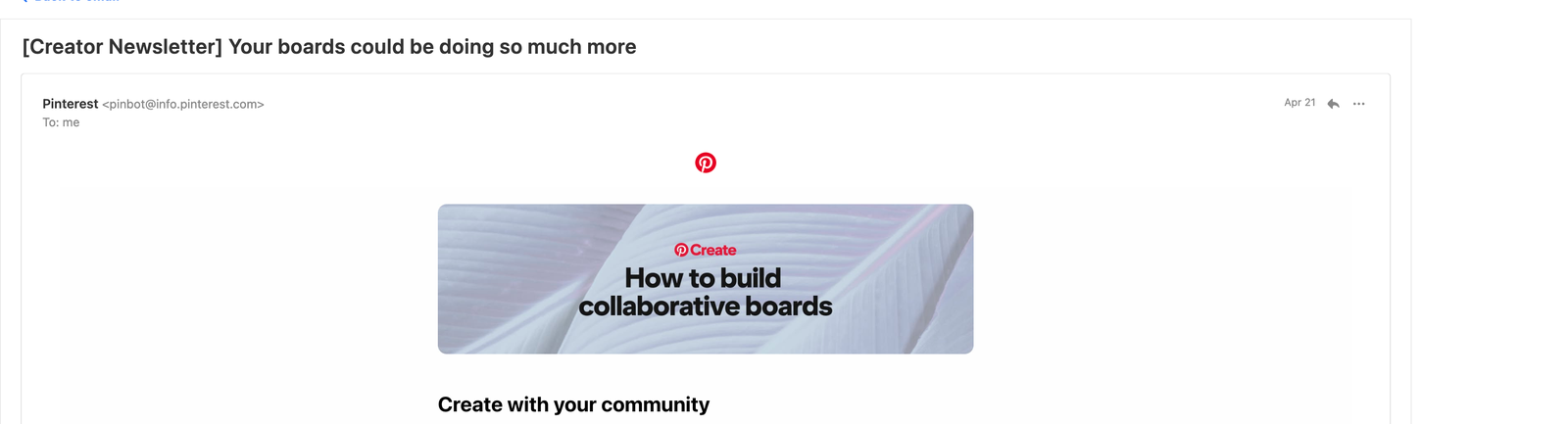
The key passage:
"Your boards can be more than a place to save ideas. They're creative workspaces where you plan, create and share with your audience."
"Start a group board. Pick one clear theme, invite collaborators and define what 'done' looks like. Save ideas to your own board first, then move the strongest ones to the group."
Then the load-bearing stat, direct from Pinterest:
"Nearly 25% of Pinterest's organic traffic goes to boards."
Why 25% changes the math
That's Pinterest's own number. Nearly a quarter of organic traffic goes to boards — and in the same email, Pinterest told creators to start group boards, the curated, collaborative kind.
If you scaled back on group-board strategy in Q1, you stepped away from a surface Pinterest itself is now pointing creators to. Fresh individual pins still matter, and Pinterest's 24-48 hour boost on new content is real — but the right read is fresh pins and active group boards, not one at the expense of the other.
What to do if you paused group boards
- Start saving to active boards you're already a member of. Owners watch contributor activity, and showing momentum before asking for anything new pays off.
- Prune the dead ones from your portfolio. A group board where nobody has added pins in months won't bring you reach. Keep the ones with real activity.
- Find new boards in your niche. This is the hard part — Pinterest's own search doesn't make group boards easy to find, and it doesn't tell you which ones accept join requests.
Where Pingroupie fits
Pingroupie started as a group board directory, and that is still its core. The Pingroupie group board directory helps with exactly that last step:
- Search by niche. Search by keyword and filter by category, minimum members and minimum followers. Sort by followers, members, pins or name.
- See the facts at a glance. Follower, member and pin counts, each with the month they were recorded, and whether the board was open to join requests.
- Check before you ask. Every board page links to the live board on Pinterest, so you can see recent activity before you send a request. Save candidates to your watchlist while you work through them.
- Start from a topic. Keyword ideas turns one topic into related terms, each linked to matching boards.
Browse the group-board directory — the first three pages and the first page of every search are free. Premium unlocks every page and every search result for $9.99/mo.
The longer read
If you're new to group boards or want the full walk-through — how to get accepted, how to contribute without getting suppressed, how to know when a board has gone stale — see our complete group-boards guide.